A2C throws away each rollout after one update. PPO wraps the policy gradient in a clipped importance ratio so you can do 10+ epochs on the same data without the policy exploding. Schulman et al. (2017). Still the default policy-gradient algorithm in 2026.
Type: Build Languages: Python Prerequisites: Phase 9 · 06 (REINFORCE), Phase 9 · 07 (Actor-Critic) Time: ~75 minutes
The Problem
A2C (Lesson 07) is on-policy: the gradient \mathbb E_{\pi_\theta}[A \cdot \nabla \log \pi_\theta] requires data sampled from the current \pi_\theta. Take one update, and \pi_\theta changes; the data you used is now off-policy. Re-use it and your gradient is biased.
Rollouts are expensive. On Atari, one rollout across 8 envs × 128 steps = 1024 transitions and a dozen seconds of environment time. Throwing that away after one gradient step is wasteful.
Trust Region Policy Optimization (TRPO, Schulman 2015) was the first fix: constrain each update so the KL divergence between old and new policy stays below \delta. Theoretically clean, but requires a conjugate-gradient solve per update. Nobody runs TRPO in 2026.
PPO (Schulman et al. 2017) replaces the hard trust-region constraint with a simple clipped objective. One extra line of code. Ten epochs per rollout. No conjugate gradients. Good-enough theoretical guarantees. Nine years later it is still the default policy-gradient algorithm for everything from MuJoCo to RLHF.
The Concept
The importance ratio.
This is the likelihood ratio of the new policy vs the policy that collected the data. r_t = 1 means no change. r_t = 2 means the new policy is twice as likely to take a_t as the old.
The clipped surrogate.
Two terms:
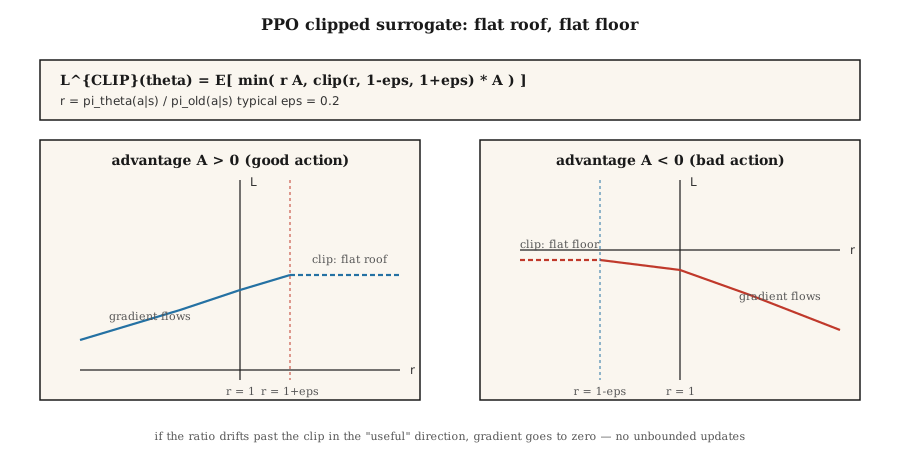
- If the advantage A_t > 0 and the ratio tries to grow past 1 + \epsilon, the clip flattens the gradient — don't push a good action further than +\epsilon above old probability.
- If the advantage A_t < 0 and the ratio tries to fall below 1 - \epsilon (meaning we would make a bad action much less likely than the old policy did), the clip flattens the gradient: don't push a bad action further than -\epsilon below old probability.
The min handles the other direction: if the ratio has moved in the beneficial direction, you still get the gradient (no clipping on the side that would hurt you).
Typical \epsilon = 0.2. Plot the objective as a function of r_t: a piecewise-linear function with a flat roof on the "good side" and a flat floor on the "bad side."
The full PPO loss.
Same actor-critic structure as A2C. Three coefficients, usually c_v = 0.5, c_e = 0.01, \epsilon = 0.2.
The training loop.
- Collect N \times T transitions across N parallel envs for T steps each.
- Compute advantages (GAE), freeze them as constants.
- Freeze \pi_{\theta_{\text{old}}} as a snapshot of current \pi_\theta.
- For K epochs, for each minibatch of
(s, a, A, V_target, log π_old(a|s)):- Compute r_t(\theta) = \exp(\log \pi_\theta(a \mid s) - \log \pi_{\text{old}}(a \mid s)).
- Apply L^{\text{CLIP}} + value loss + entropy.
- Gradient step.
- Discard the rollout. Return to step 1.
K = 10 and minibatches of 64 is a standard hyperparameter set. PPO is robust: the exact numbers rarely matter within ±50%.
KL-penalty variant. The original paper proposed an alternative using an adaptive KL penalty: L = L^{\text{PG}} - \beta \cdot \mathrm{KL}(\pi_\theta \Vert \pi_{\text{old}}) with \beta adjusted based on observed KL. The clipping version became dominant; the KL variant survives in RLHF (where KL to the reference policy is a separate constraint you always want anyway).
ppo clip
Build It
Step 1: capture log π_old(a | s) at rollout time
for step in range(T):
    probs = softmax(logits(theta, state_features(s)))
    a = sample(probs, rng)
    s_next, r, done = env.step(s, a)
    buffer.append({
        "s": s, "a": a, "r": r, "done": done,
        "v_old": value(w, state_features(s)),
        "log_pi_old": log(probs[a] + 1e-12),
    })
    s = s_next
The snapshot is taken once, at rollout time. It does not change during the update epochs.
Step 2: compute GAE advantages (Lesson 07)
Same as A2C. Normalize across the batch.
Step 3: clipped surrogate update
for _ in range(K_EPOCHS):
    for mb in minibatches(buffer, size=64):
        for rec in mb:
            x = state_features(rec["s"])
            probs = softmax(logits(theta, x))
            logp = log(probs[rec["a"]] + 1e-12)
            ratio = exp(logp - rec["log_pi_old"])
            adv = rec["advantage"]
            surrogate = min(
                ratio * adv,
                clamp(ratio, 1 - EPS, 1 + EPS) * adv,
            )
            # backprop -surrogate, add value loss, subtract entropy
            grad_logpi = onehot(rec["a"]) - probs
            if (adv > 0 and ratio >= 1 + EPS) or (adv < 0 and ratio <= 1 - EPS):
                pg_grad = 0.0  # clipped
            else:
                pg_grad = ratio * adv
            for i in range(N_ACTIONS):
                for j in range(N_FEAT):
                    theta[i][j] += LR * pg_grad * grad_logpi[i] * x[j]
The "clipped → zero gradient" pattern is the heart of PPO. If the new policy has already drifted too far in the beneficial direction, the update stops.
Step 4: value and entropy
Add standard MSE to the critic target and an entropy bonus on the actor, same as A2C.
Step 5: diagnostics
Three things to watch every update:
- Mean KL \mathbb{E}[\log \pi_{\text{old}} - \log \pi_\theta]. Should stay in
[0, 0.02]. If it blows past0.1, reduceK_EPOCHSorLR. - Clip fraction — the fraction of samples whose ratio lies outside [1-\epsilon, 1+\epsilon]. Should be
~0.1-0.3. If~0, the clip never triggers → raiseLRorK_EPOCHS. If~0.5+, you are over-fitting the rollout → lower them. - Explained variance 1 - \text{Var}(V_{\text{target}} - V_{\text{pred}}) / \text{Var}(V_{\text{target}}). Critic quality metric. Should climb toward 1 as the critic learns.
Pitfalls
- Clip coefficient mistuned. \epsilon = 0.2 is the de-facto standard. Going to
0.1makes updates too timid;0.3+invites instability. - Too many epochs. K > 20 routinely destabilizes because the policy drifts far from \pi_{\text{old}}. Cap epochs, especially for large networks.
- No reward normalization. Large reward scales eat into the clip range. Normalize rewards (running std) before computing advantages.
- Forgetting advantage normalization. Per-batch zero-mean/unit-std normalization is standard. Skipping it wrecks PPO on most benchmarks.
- Learning rate not decayed. PPO benefits from linear LR decay to zero. Constant LR is often worse.
- Importance ratio math errors. Always
exp(log_new - log_old)for numerical stability, notnew / old. - Wrong gradient sign. Maximize the surrogate = minimize -L^{\text{CLIP}}. A flipped sign is the most common PPO bug.
Use It
PPO is 2026's default RL algorithm across a surprising number of domains:
| Use case | PPO variant |
|---|---|
| MuJoCo / robotics control | PPO with Gaussian policy, GAE(0.95) |
| Atari / discrete games | PPO with categorical policy, rolling 128-step rollouts |
| RLHF for LLMs | PPO with KL penalty to reference model, reward from RM at end of response |
| Large-scale game agents | IMPALA + PPO (AlphaStar, OpenAI Five) |
| Reasoning LLMs | GRPO (Lesson 12) — PPO variant without critic |
| Preference-only data | DPO — closed-form collapsing of PPO+KL, no online sampling |
The PPO loss shape — clipped surrogate + value + entropy — is the scaffolding for DPO, GRPO, and nearly every RLHF pipeline.
Ship It
Save as outputs/skill-ppo-trainer.md:
---
name: ppo-trainer
description: Produce a PPO training config and a diagnostic plan for a given environment.
version: 1.0.0
phase: 9
lesson: 8
tags: [rl, ppo, policy-gradient]
---

Given an environment and training budget, output:

1. Rollout size. `N` envs × `T` steps.
2. Update schedule. `K` epochs, minibatch size, LR schedule.
3. Surrogate params. `ε` (clip), `c_v`, `c_e`, advantage normalization on.
4. Advantage. GAE(`λ`) with explicit `γ` and `λ`.
5. Diagnostics plan. KL, clip fraction, explained variance thresholds with alerts.

Refuse `K > 30` or `ε > 0.3` (unsafe trust region). Refuse any PPO run without advantage normalization or KL/clip monitoring. Flag clip fraction sustained above 0.4 as drift.
Exercises
- Easy. Run PPO on 4×4 GridWorld with \epsilon=0.2, K=4. Compare sample efficiency to A2C (one epoch per rollout) at matched env steps.
- Medium. Sweep K \in \lbrace 1, 4, 10, 30 \rbrace. Plot return vs env steps and track mean KL per update. At what K does KL explode on this task?
- Hard. Replace the clipped surrogate with an adaptive KL penalty (\beta doubled if \mathrm{KL} > 2 \cdot \text{target}, halved if \mathrm{KL} < \text{target}/2). Compare final return, stability, and clip-free-ness.
Key Terms
| Term | What people say | What it actually means |
|---|---|---|
| Importance ratio | "r_t(θ)" | \pi_\theta(a \mid s) / \pi_{\text{old}}(a \mid s); deviation from the policy that collected the data. |
| Clipped surrogate | "PPO's main trick" | \min(r \cdot A, \mathop{\mathrm{clip}}(r, 1-\epsilon, 1+\epsilon) \cdot A); flat gradient past the clip on beneficial side. |
| Trust region | "TRPO / PPO intent" | Limit each update's KL to guarantee monotone improvement. |
| KL penalty | "Soft trust region" | Alternative PPO: L - \beta \cdot \mathrm{KL}(\pi_\theta \Vert \pi_{\text{old}}). Adaptive \beta. |
| Clip fraction | "How often clipping triggers" | Diagnostic — should be 0.1-0.3; outside means mistuned. |
| Multi-epoch training | "Data reuse" | K epochs on each rollout; variance cost traded for sample efficiency. |
| On-policy-ish | "Mostly on-policy" | PPO is nominally on-policy but K>1 epochs uses slightly-off-policy data safely. |
| PPO-KL | "The other PPO" | KL-penalty variant; used in RLHF where KL-to-reference is already a constraint. |
Further Reading
- Schulman et al. (2017). Proximal Policy Optimization Algorithms — the paper.
- Schulman et al. (2015). Trust Region Policy Optimization — TRPO, PPO's predecessor.
- Andrychowicz et al. (2021). What Matters In On-Policy RL? A Large-Scale Empirical Study — every PPO hyperparameter ablated.
- Ouyang et al. (2022). Training language models to follow instructions with human feedback — InstructGPT; the PPO-in-RLHF recipe.
- OpenAI Spinning Up — PPO — clean modern exposition with PyTorch.
- CleanRL PPO implementation — reference single-file PPO used by many papers.
- Hugging Face TRL — PPOTrainer — the production recipe for PPO on language models; read alongside Lesson 09 (RLHF).
- Engstrom et al. (2020). Implementation Matters in Deep Policy Gradients — the "37 code-level optimizations" paper; which PPO tricks are load-bearing and which are folklore.
