A persistent memory workbench with revision history and one boundary for REST and MCP.
Node 22.18+, Rust 2021 and Python 3 for the grader; promises, append logs, HTTP, namespaces, revisions and vector dot products. The core uses standard libraries. The grader checks your selected workspace; it never fills in missing behavior from the reference.
Build and run your version
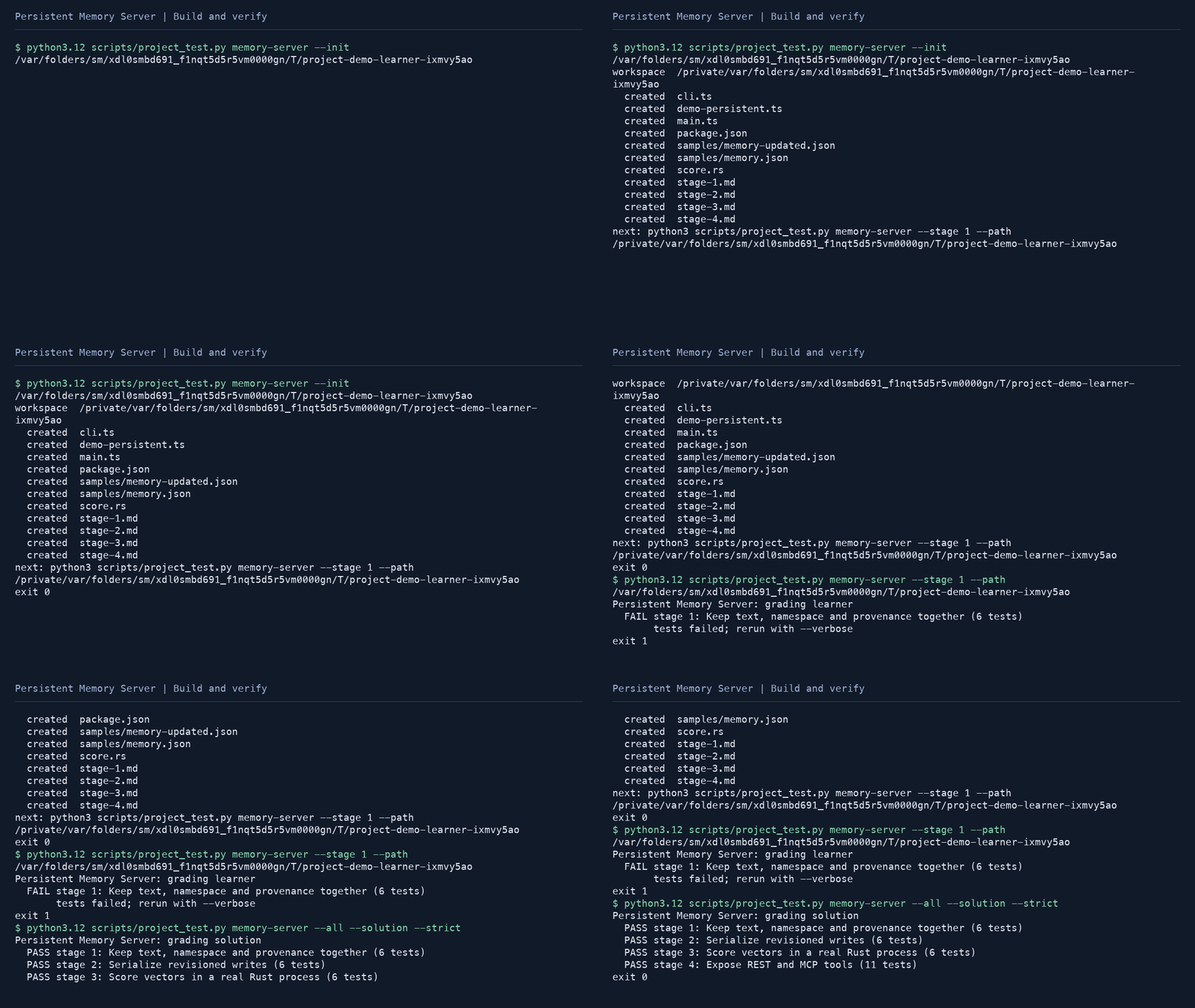
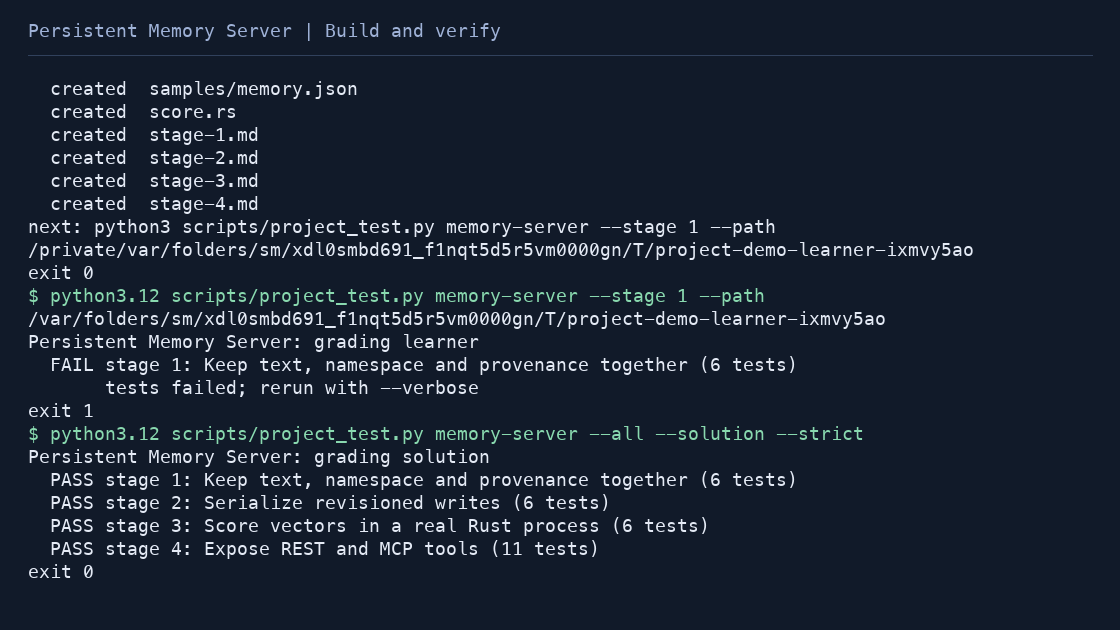
From the repository root, initialize once. A fresh starter fails intentionally.
python3 scripts/project_test.py memory-server --init learning-artifacts/memory-server
python3 scripts/project_test.py memory-server --stage 1 --path learning-artifacts/memory-server --strict
Implement each stage, then run the cumulative grader and the supplied input driver:
python3 scripts/project_test.py memory-server --all --path learning-artifacts/memory-server --strict
cd learning-artifacts/memory-server
node cli.ts --data-dir memory-data --put samples/memory.json
node cli.ts --data-dir memory-data --query "cache policy"
node cli.ts --data-dir memory-data --history cache-policy
The driver and offline samples are provided scaffolding. Its imports resolve to your implementation. Public input types and function signatures live in the starter and API contract.
Inspect the reference separately
From the repository root:
python3 scripts/project_test.py memory-server --all --solution --strict
cd projects/memory-server/solution
node cli.ts --data-dir memory-data --put samples/memory.json
node cli.ts --data-dir memory-data --query "cache policy"
node cli.ts --data-dir memory-data --history cache-policy
Observe the change
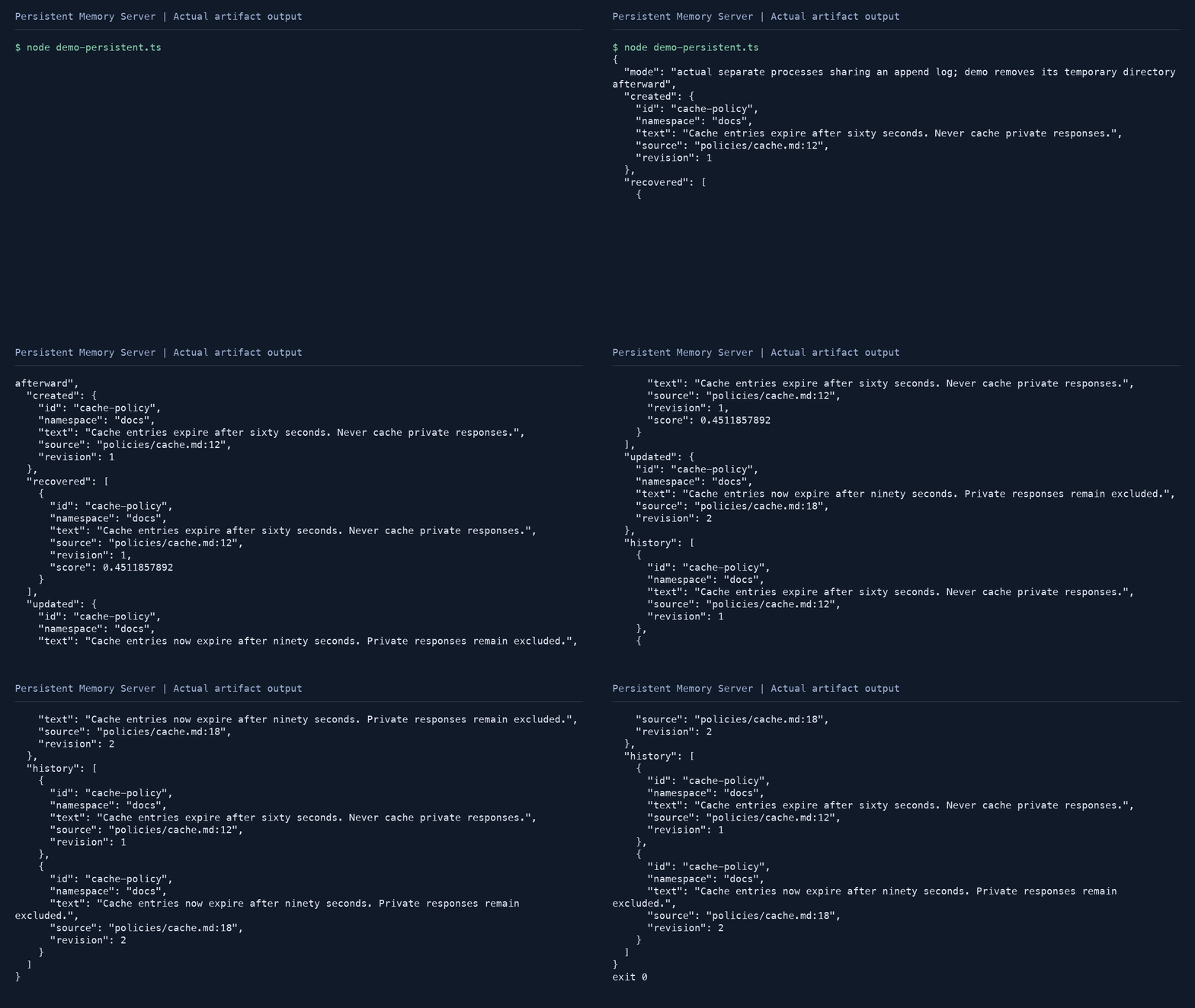
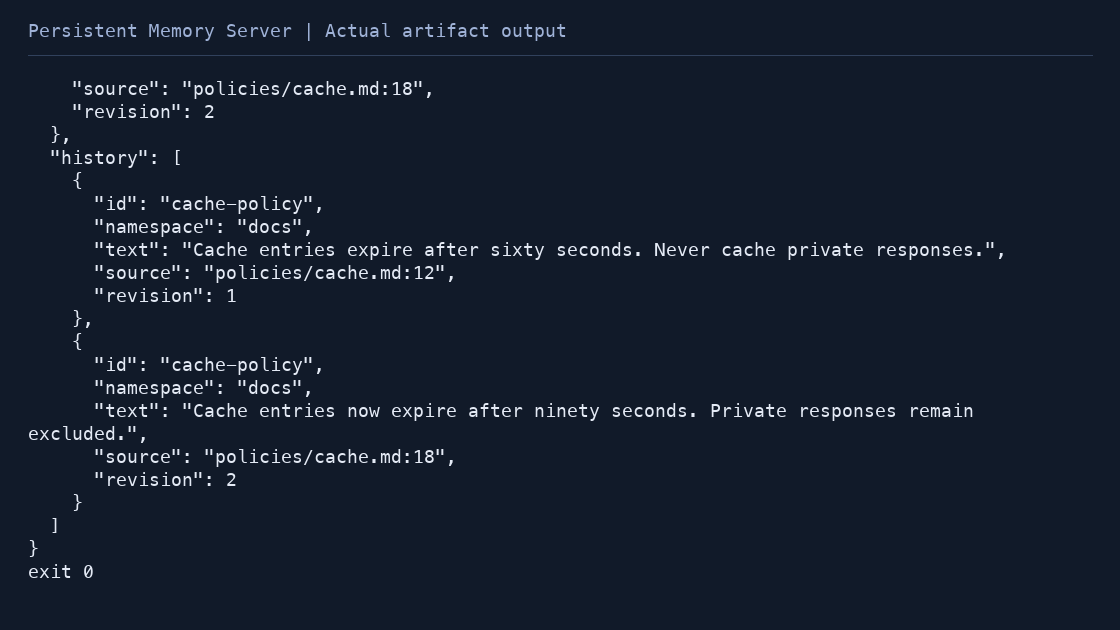
A first process appends revision 1. A separate process recovers and searches that record with its source. Updating with --revision 1 appends revision 2; repeating revision 0 fails and leaves the log unchanged.
Edit a copy of the sample and rerun the command. Keep the input beside the output so someone else can reproduce the result; the supplied samples are authored teaching data.
Integration and limits
Set MEMORY_TOKEN in the environment and run node cli.ts --data-dir memory-data --serve --port 8788. REST and MCP share the same store; no token is written into files.
Use one writer process per data directory. Appended JSONL is restart persistence, not a power-loss or multi-process transaction guarantee. Hashed lexical vectors are not semantic embeddings. MCP HTTP is a documented tools subset without streaming or sessions.
For persistent serving, set MEMORY_TOKEN in your environment, then run:
node cli.ts --data-dir memory-data --serve --port 8788Restart with the same directory to recover history. Use a new id or --revision 1 when updating the initial sample; rerunning its creation with revision 0 is intentionally a conflict.
Stages
- Keep text, namespace and provenance together
- Serialize revisioned writes
- Score vectors in a real Rust process
- Expose REST and MCP tools
Primary references
MCP tools specification Rust standard library Node HTTP API
Optional standard MCP client verification
The optional track uses mcp==2.1.1, the installed official Python client, against this project's actual loopback HTTP server. It negotiates the declared 2025-11-25 legacy tools contract. This does not establish support for every newer protocol feature.
python3 -m venv .venv-mcp
.venv-mcp/bin/python -m pip install -r projects/memory-server/requirements-framework.txt
.venv-mcp/bin/python scripts/project_test.py memory-server --all --solution --optional --strict
Use --path learning-artifacts/memory-server to run the same client against your implementation. The default track stays standard-library-only; missing optional packages produce SKIP, which fails strict optional grading.
Compare a source change
After the initial sample write, run these commands in the same completed workspace:
node cli.ts --data-dir memory-data --put samples/memory-updated.json --revision 1
node cli.ts --data-dir memory-data --history cache-policy --html history.html
The comparison table keeps both source locators and revisions. Revision 1 says sixty seconds at policies/cache.md:12; revision 2 says ninety seconds at line 18. Retaining the old source makes the change reviewable. The server does not verify that an external source file still matches its stored text.