A scoped cloud incident reader with an execution receipt for every cache hit and retry.
Python 3.10+; JSON, sets, exceptions, callbacks and environment configuration. Optional SDK comparisons use requirements-framework.txt. The core uses standard libraries. The grader checks your selected workspace; it never fills in missing behavior from the reference.
Build and run your version
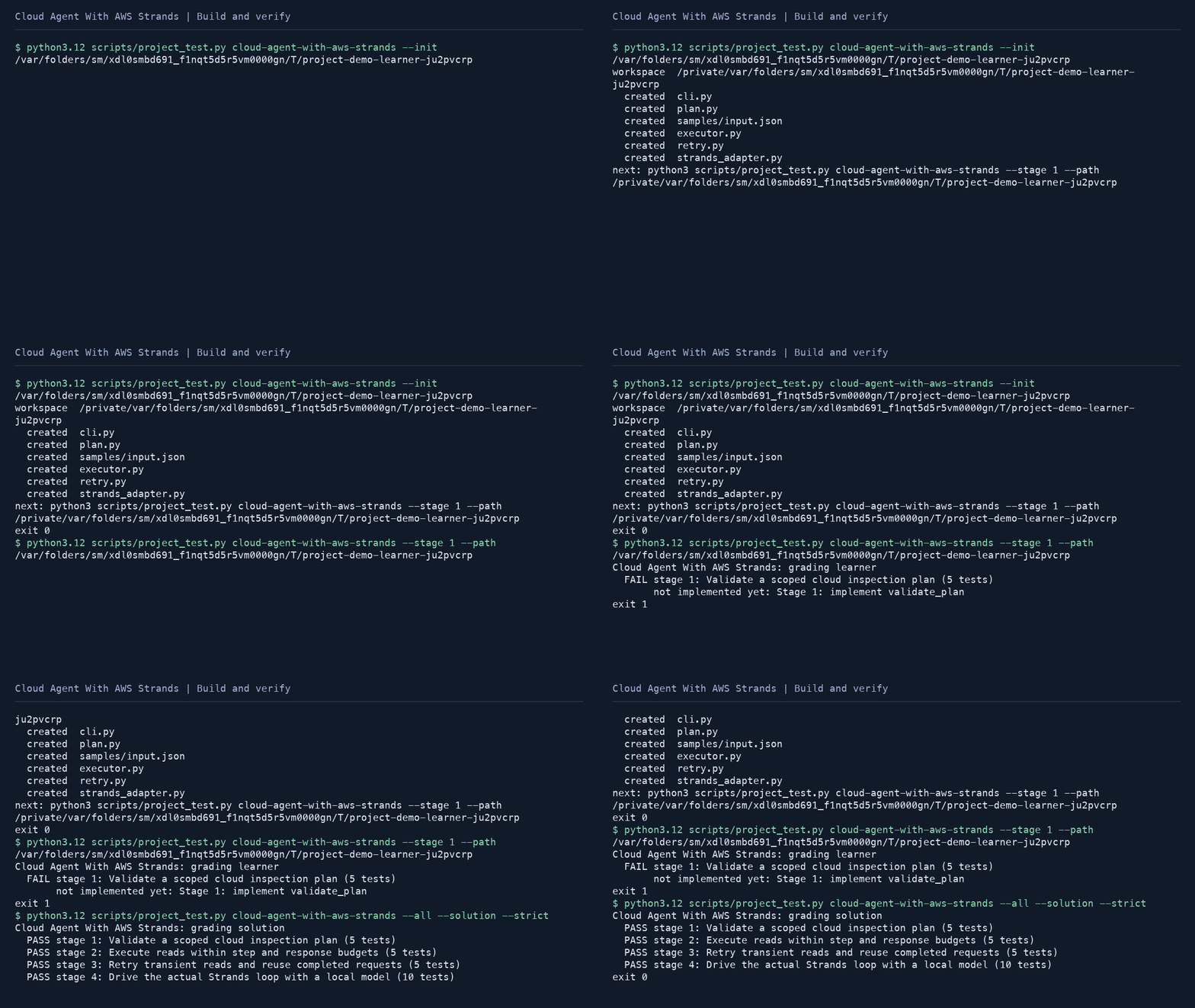
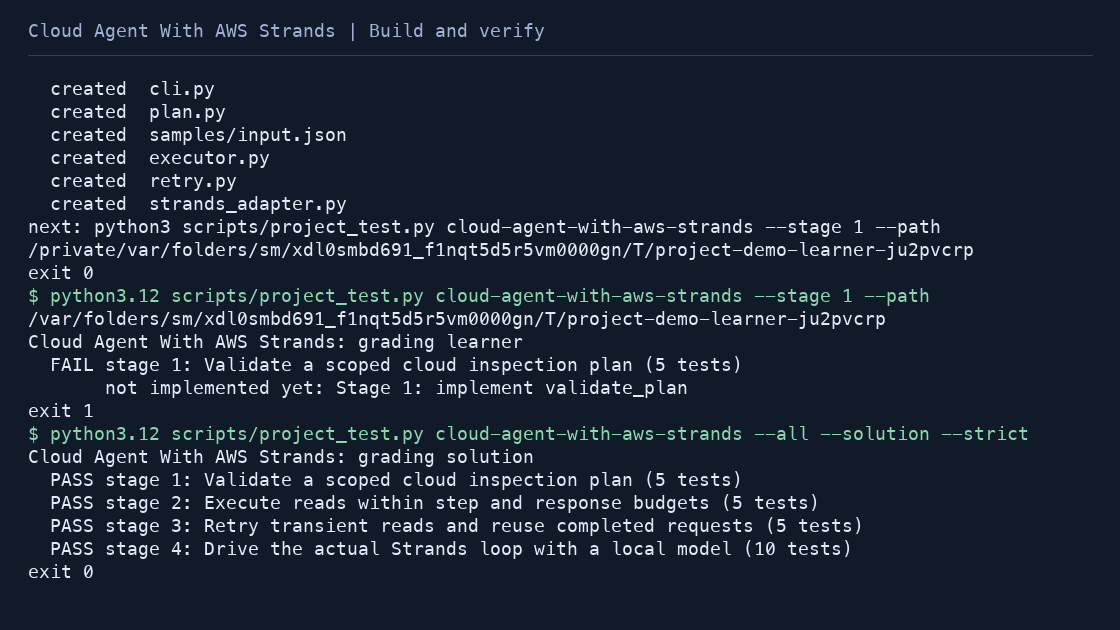
From the repository root, initialize once. A fresh starter fails intentionally.
python3 scripts/project_test.py cloud-agent-with-aws-strands --init learning-artifacts/cloud-agent-with-aws-strands
python3 scripts/project_test.py cloud-agent-with-aws-strands --stage 1 --path learning-artifacts/cloud-agent-with-aws-strands --strict
Implement each stage, then run the cumulative grader and the supplied input driver:
python3 scripts/project_test.py cloud-agent-with-aws-strands --all --path learning-artifacts/cloud-agent-with-aws-strands --strict
cd learning-artifacts/cloud-agent-with-aws-strands
python3 cli.py samples/input.json --output incident.json
The driver and offline samples are provided scaffolding. Its imports resolve to your implementation. Public input types and function signatures live in the starter and API contract.
Inspect the reference separately
From the repository root:
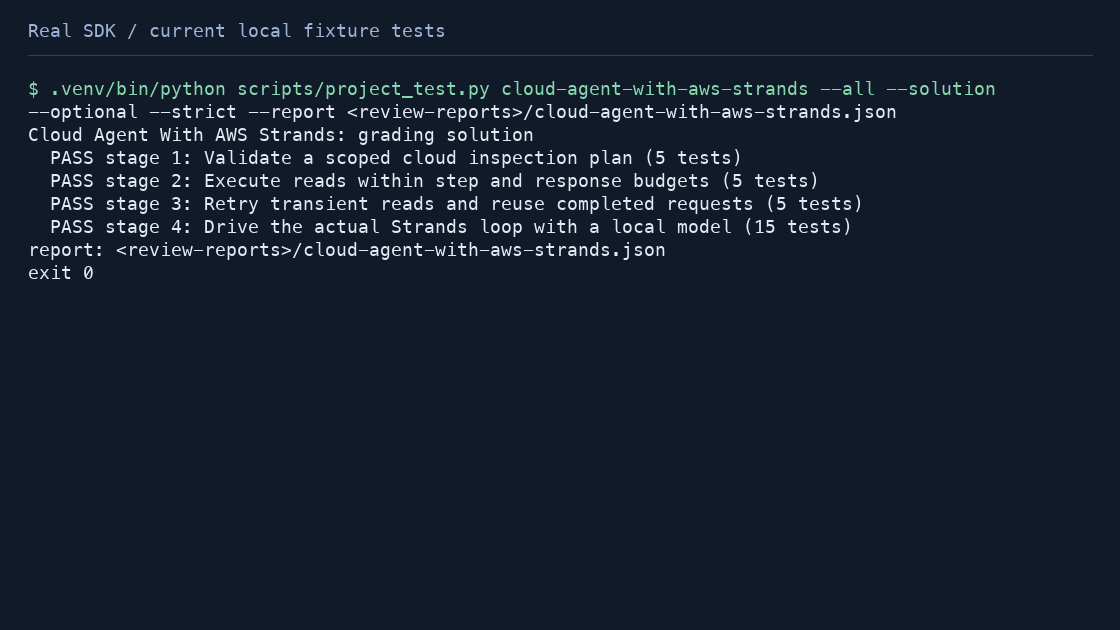
python3 scripts/project_test.py cloud-agent-with-aws-strands --all --solution --strict
cd projects/cloud-agent-with-aws-strands/solution
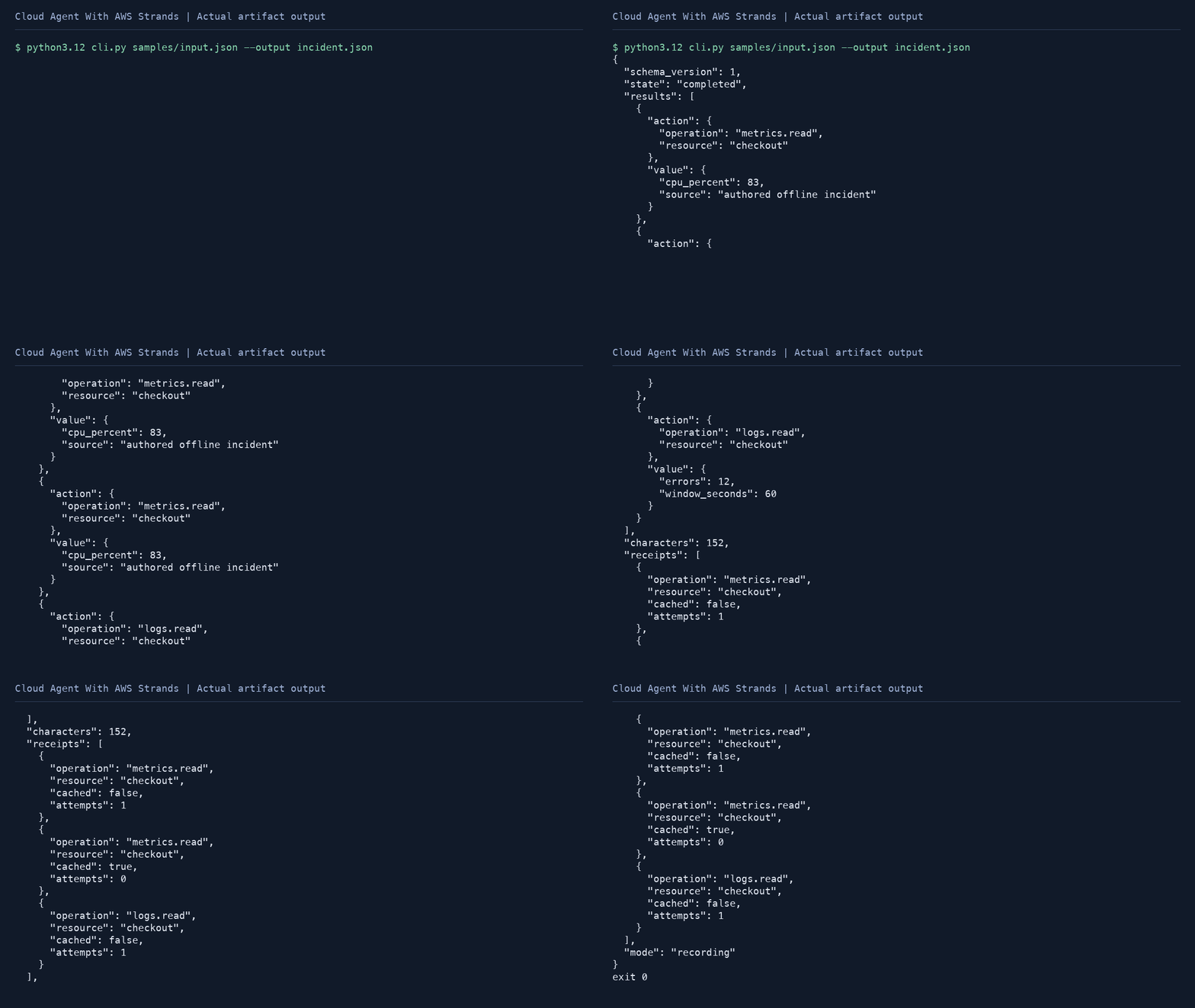
python3 cli.py samples/input.json --output incident.json
Observe the change
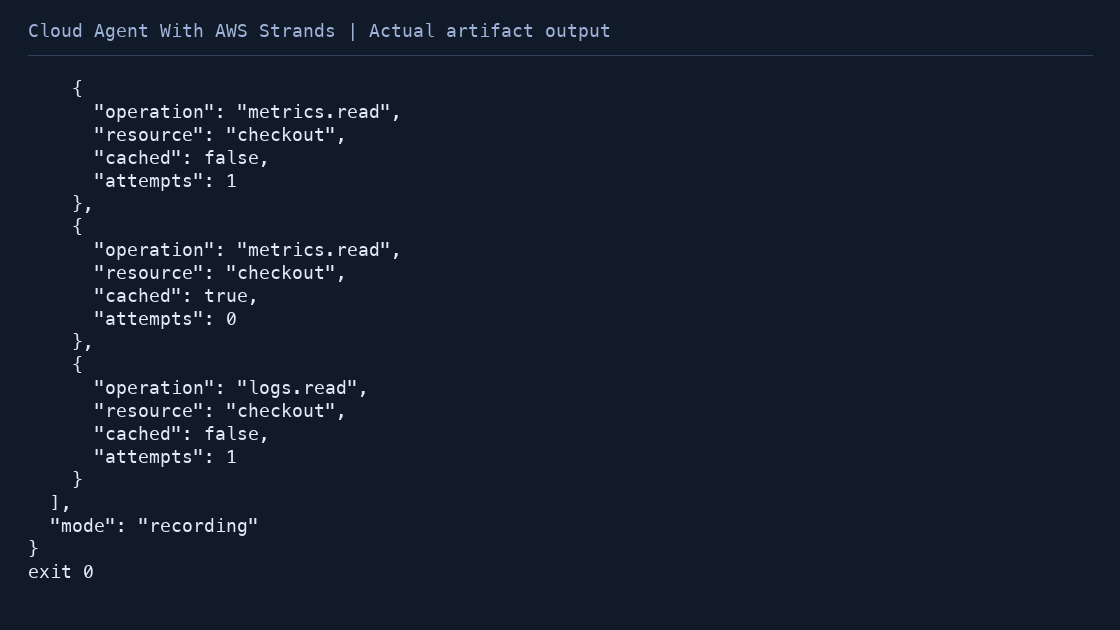
Three planned reads produce three retained results but only two provider reads because repeated metrics.read uses the request-local cache. The receipt exposes both calls and reuse.
Edit a copy of the sample and rerun the command. Keep the input beside the output so someone else can reproduce the result; the supplied samples are authored teaching data.
Integration and limits
Import run(payload, provider). The provider receives only a validated operation and scoped resource. The optional Strands model proposes a plan; it never bypasses the deterministic validator.
Default mode reads the supplied recording. --mode aws is an opt-in AWS CLI adapter for ECS services, CloudWatch CPU and bounded log reads; it requires caller configuration, credentials and AWS permissions. No deployment or live verification is implied.
Stages
- Validate a scoped cloud inspection plan
- Execute reads within step and response budgets
- Retry transient reads and reuse completed requests
- Drive the actual Strands loop with a local model
Optional framework integration
The baseline stages use only the standard library. The framework adapter is implemented and has a separate smoke test that uses the real installed SDK with a local fake model. It never contacts a cloud service.
python3 -m venv .venv
.venv/bin/python -m pip install -r projects/cloud-agent-with-aws-strands/requirements-framework.txt
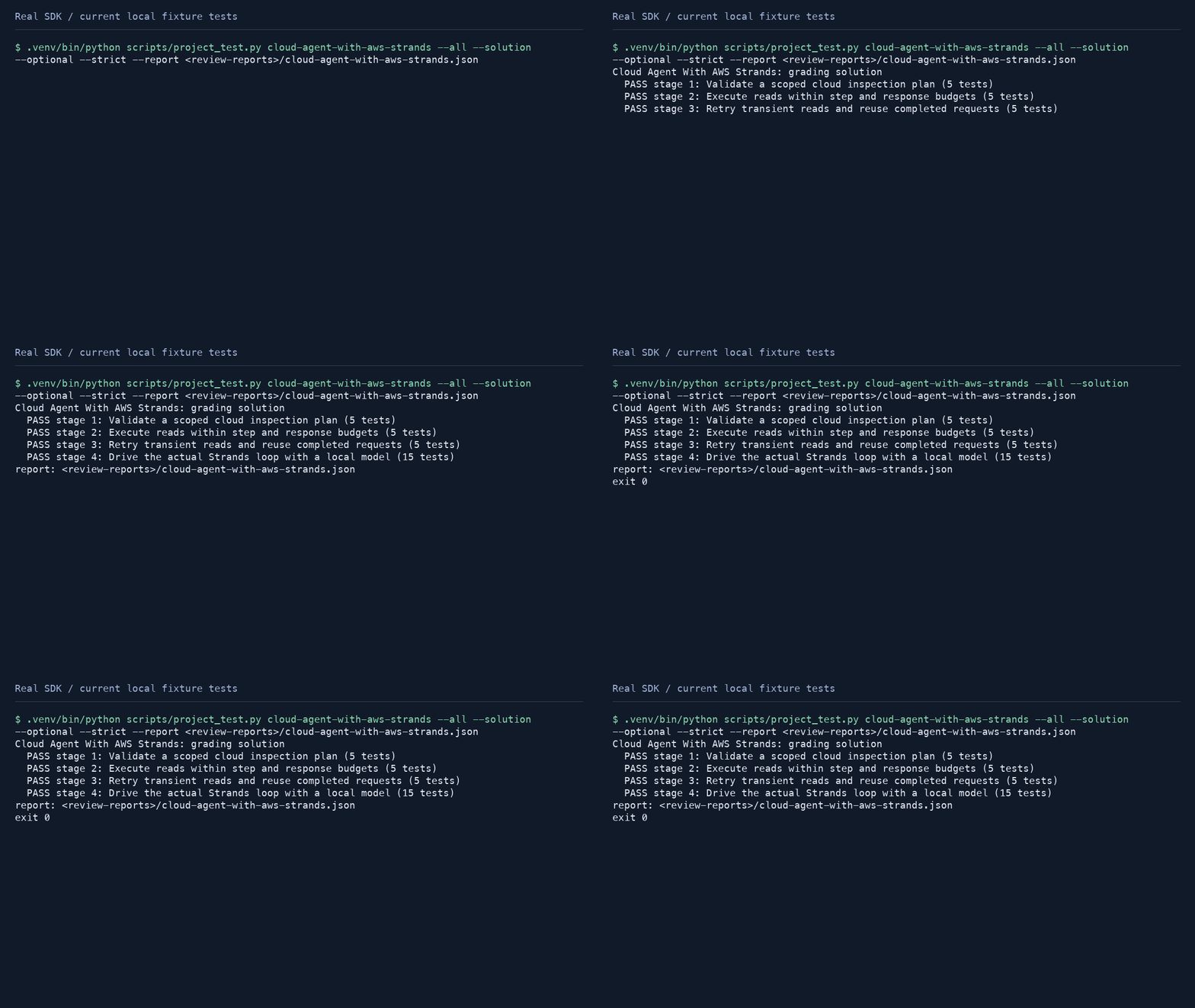
.venv/bin/python scripts/project_test.py cloud-agent-with-aws-strands --solution --optional --strict
.venv/bin/python projects/cloud-agent-with-aws-strands/solution/framework_demo.py
The integration was verified against strands-agents==1.57.1. The cloud-provider path, where present, remains opt-in and requires your own environment credentials; no cloud deployment is performed.
The default grader covers the offline core and input integration. --optional adds 5 tests that use the real SDK and a deterministic local model. A missing SDK is reported as SKIP with an install hint; --optional --strict fails when the dependency is missing. Passing only the default tests does not claim framework verification.
Primary references
Strands custom model providers explains the optional deterministic model adapter.
Configure the optional AWS reader
Before --mode aws, add an aws object keyed by each scoped service. Every entry needs region. inventory.list and metrics.read also need cluster; logs.read needs log_group. metrics.read requires start and end as timezone-aware ISO timestamps, such as 2026-01-01T00:00:00Z and 2026-01-01T01:00:00Z. logs.read accepts the same optional pair, converted to epoch milliseconds for --start-time and --end-time. Omitting both preserves an unwindowed log read; supplying only one is an error. Both operations reject invalid, timezone-free, pre-epoch or non-increasing windows. The adapter issues ECS describe-services, CloudWatch get-metric-statistics for CPUUtilization and Logs filter-log-events with limit 20.
Credentials come from the AWS CLI's environment or configured credential chain. Scope validation does not replace IAM: configure permission for only the intended reads and service resources. Region and time window are caller configuration, not model-supplied executable arguments. Each CLI call has a ten-second timeout; only timeout errors are retried.