A scoped MCP inventory server that discovers schemas inside a measured context budget.
Python 3.10+, Node 22.18+, dictionaries, JSON-RPC request ids, stdin/stdout and child processes. The core uses standard libraries. The grader checks your selected workspace; it never fills in missing behavior from the reference.
Build and run your version
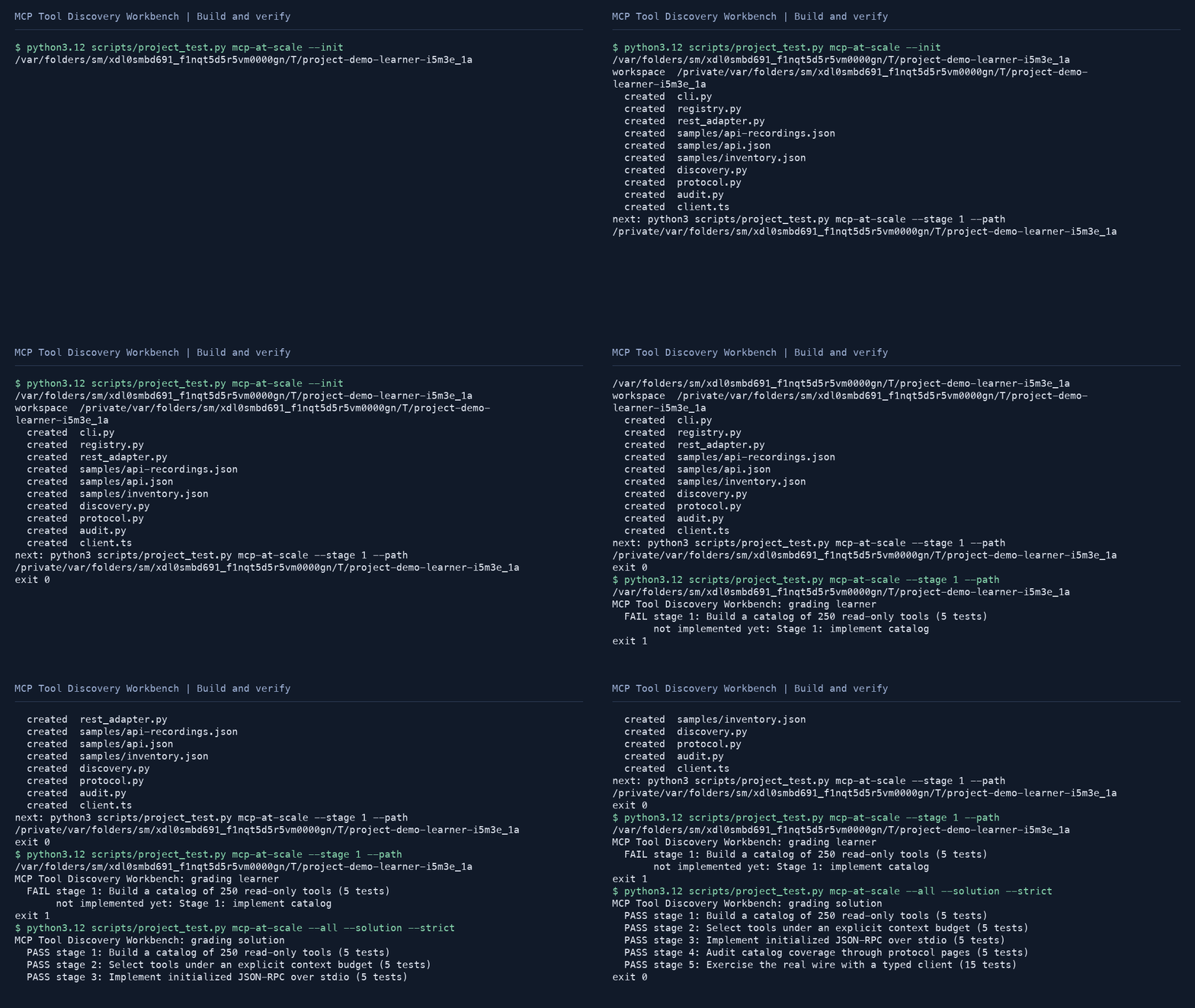
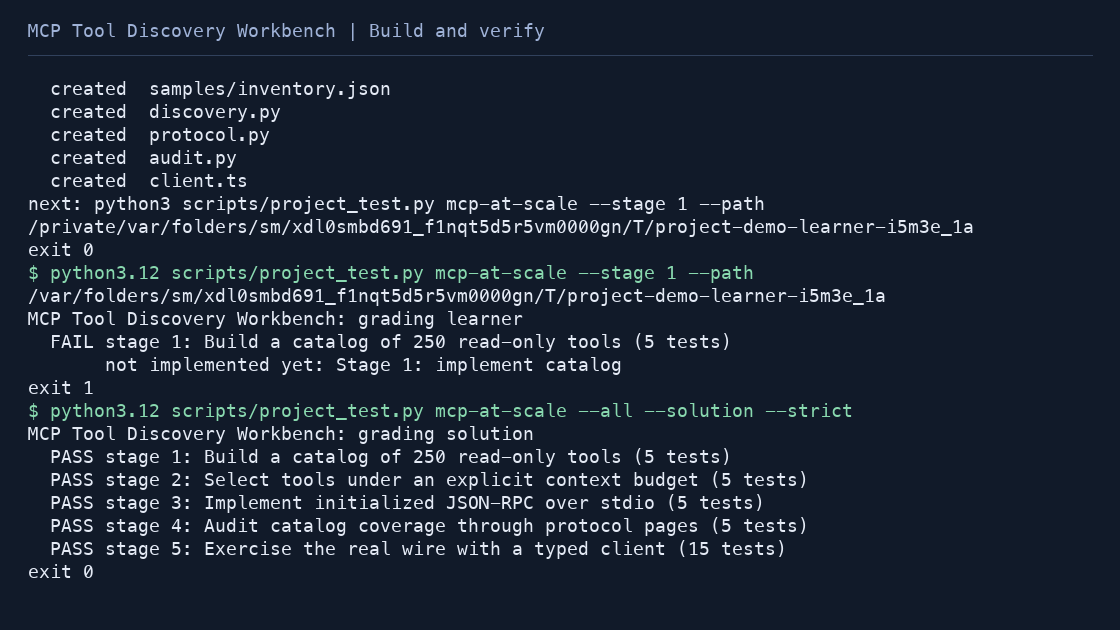
From the repository root, initialize once. A fresh starter fails intentionally.
python3 scripts/project_test.py mcp-at-scale --init learning-artifacts/mcp-at-scale
python3 scripts/project_test.py mcp-at-scale --stage 1 --path learning-artifacts/mcp-at-scale --strict
Implement each stage, then run the cumulative grader and the supplied input driver:
python3 scripts/project_test.py mcp-at-scale --all --path learning-artifacts/mcp-at-scale --strict
cd learning-artifacts/mcp-at-scale
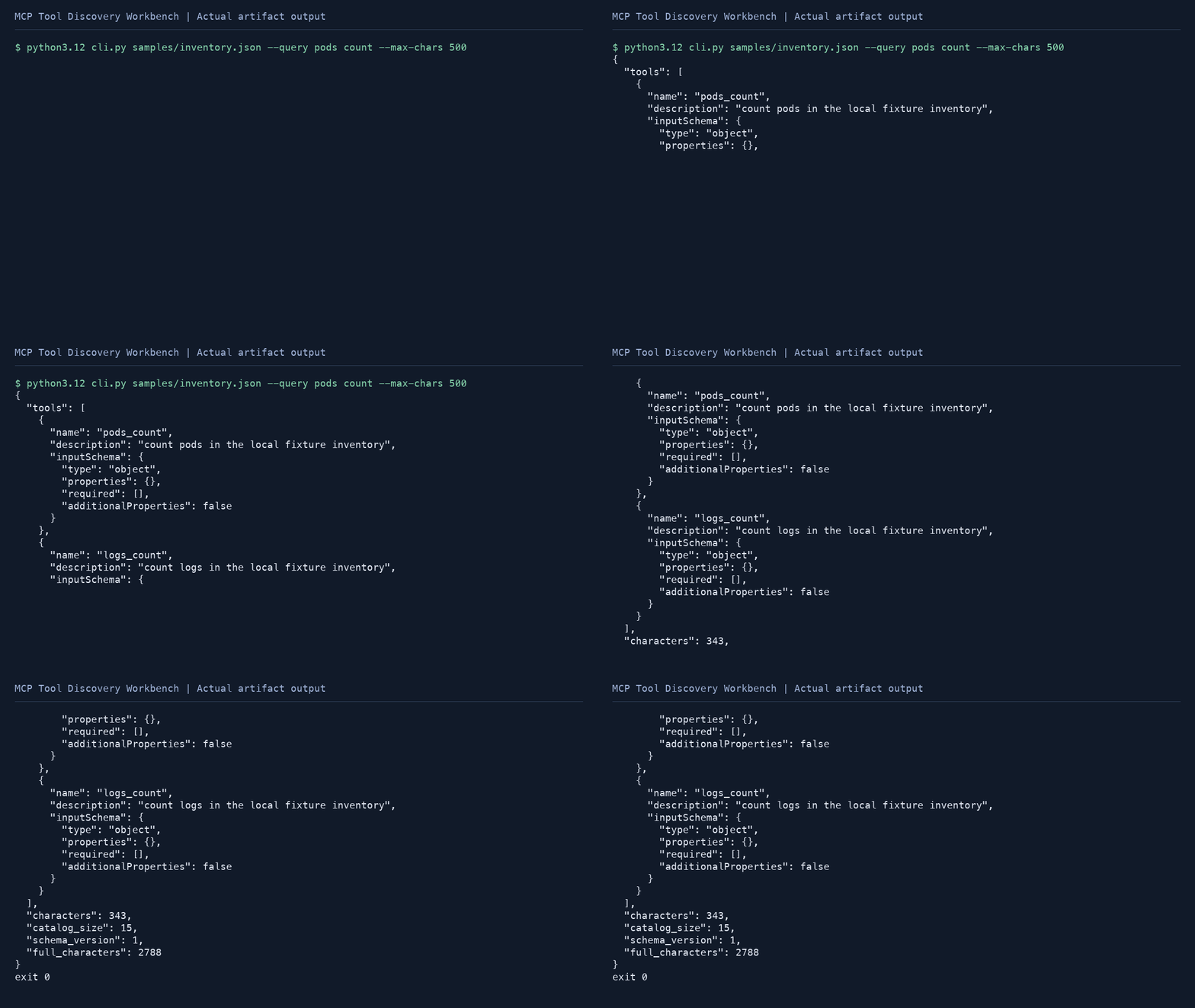
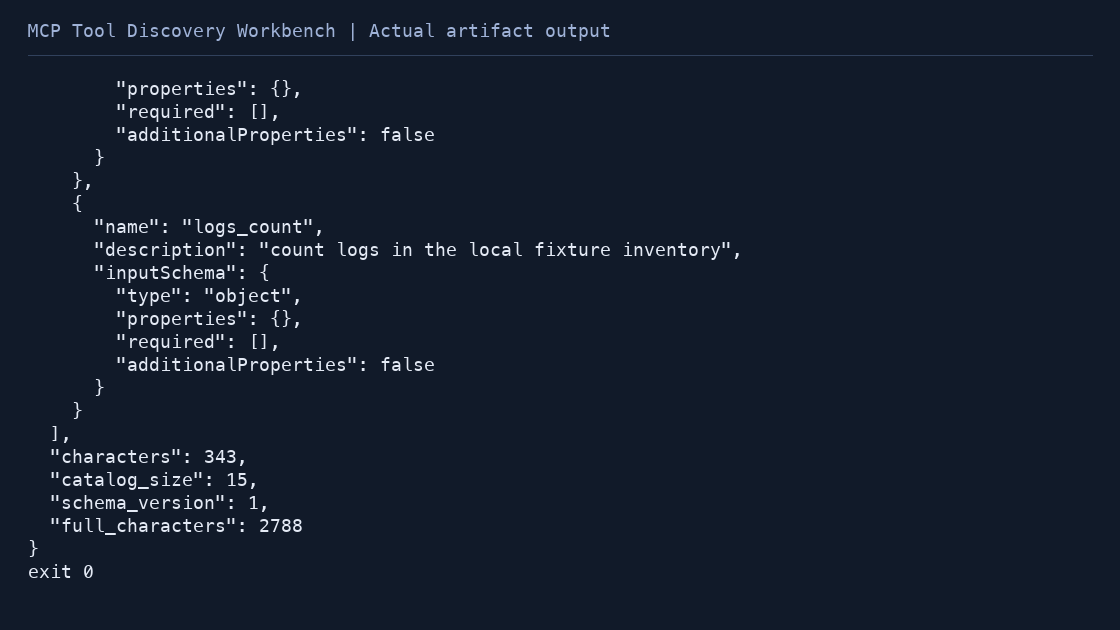
python3 cli.py samples/inventory.json --query "pods count" --max-chars 500
The driver and offline samples are provided scaffolding. Its imports resolve to your implementation. Public input types and function signatures live in the starter and API contract.
Inspect the reference separately
From the repository root:
python3 scripts/project_test.py mcp-at-scale --all --solution --strict
cd projects/mcp-at-scale/solution
python3 cli.py samples/inventory.json --query "pods count" --max-chars 500
Observe the change
The file supplies three resource families, exposing fifteen read tools plus catalog_search. Search returns the best matching schema within the exact serialized tools-array budget. The exhaustive teaching registry remains 250 tools.
Edit a copy of the sample and rerun the command. Keep the input beside the output so someone else can reproduce the result; the supplied samples are authored teaching data.
Integration and limits
Run python3 cli.py /absolute/inventory.json --serve as a stdio server. tools/call catalog_search takes query, max_chars and k; the response returns selected public schemas and their character count.
The stdio transport implements the documented 2025-06-18 and 2025-11-25 initialization/tools subset. It is not a claim of full current MCP conformance. Inventory reads are local recordings; the generated tool count is not 250 distinct integrations.
Stages
- Build a catalog of 250 read-only tools
- Select tools under an explicit context budget
- Implement initialized JSON-RPC over stdio
- Audit catalog coverage through protocol pages
- Exercise the real wire with a typed client
Primary references
Optional standard MCP client verification
The optional track uses mcp==2.1.1, the installed official Python client, against this project's actual stdio process. It negotiates the declared 2025-11-25 legacy tools contract. This does not establish support for every newer protocol feature.
python3 -m venv .venv-mcp
.venv-mcp/bin/python -m pip install -r projects/mcp-at-scale/requirements-framework.txt
.venv-mcp/bin/python scripts/project_test.py mcp-at-scale --all --solution --optional --strict
Use --path learning-artifacts/mcp-at-scale to run the same client against your implementation. The default track stays standard-library-only; missing optional packages produce SKIP, which fails strict optional grading.
Import a small REST contract
rest_adapter.py imports OpenAPI 3 GET operations with unique operationId and primitive path/query parameters. Unsupported parameter forms fail explicitly; write operations are excluded. Each imported operation retains the canonical source-spec SHA-256.
python3 cli.py samples/api-recordings.json --openapi samples/api.json --query "incident" --max-chars 800
python3 cli.py samples/api-recordings.json --openapi samples/api.json --serve
Call incident_get with {"id":"checkout-1"}. The authored recording must match the supplied arguments; a different id is rejected instead of receiving a misleading canned answer. --base-url http://127.0.0.1:PORT explicitly enables actual GETs against your loopback fixture. Redirects and non-loopback endpoints are rejected, requests time out after five seconds and response bytes are capped at one megabyte. This narrow importer does not promise full OpenAPI coverage.