A review disagreement workbench that measures when quorum helps and when it hides findings.
Node 22.18+ and Python 3 for the grader; TypeScript objects, sets, promises, AbortSignal and precision/recall. The core uses standard libraries. The grader checks your selected workspace; it never fills in missing behavior from the reference.
Build and run your version
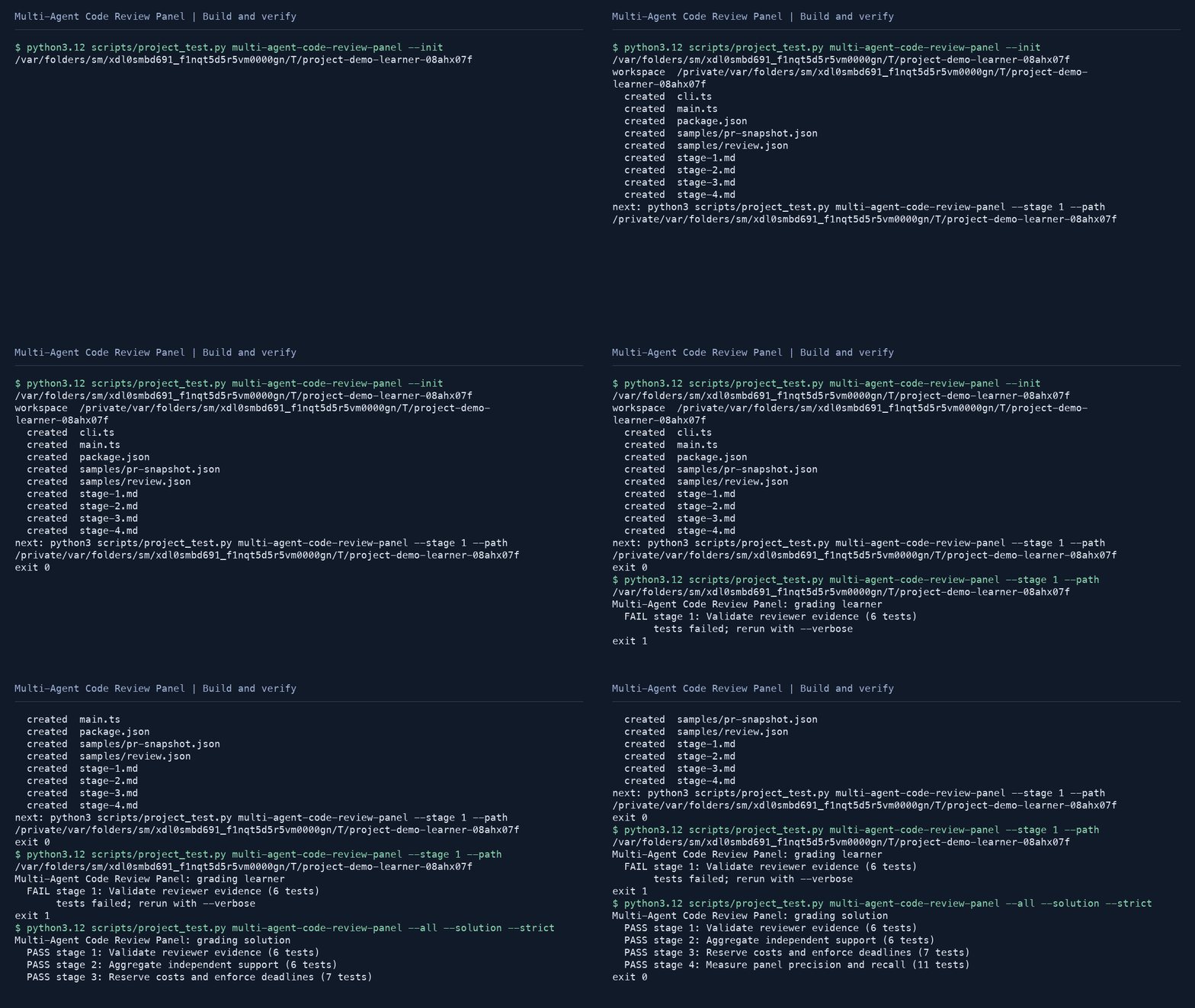
From the repository root, initialize once. A fresh starter fails intentionally.
python3 scripts/project_test.py multi-agent-code-review-panel --init learning-artifacts/multi-agent-code-review-panel
python3 scripts/project_test.py multi-agent-code-review-panel --stage 1 --path learning-artifacts/multi-agent-code-review-panel --strict
Implement each stage, then run the cumulative grader and the supplied input driver:
python3 scripts/project_test.py multi-agent-code-review-panel --all --path learning-artifacts/multi-agent-code-review-panel --strict
cd learning-artifacts/multi-agent-code-review-panel
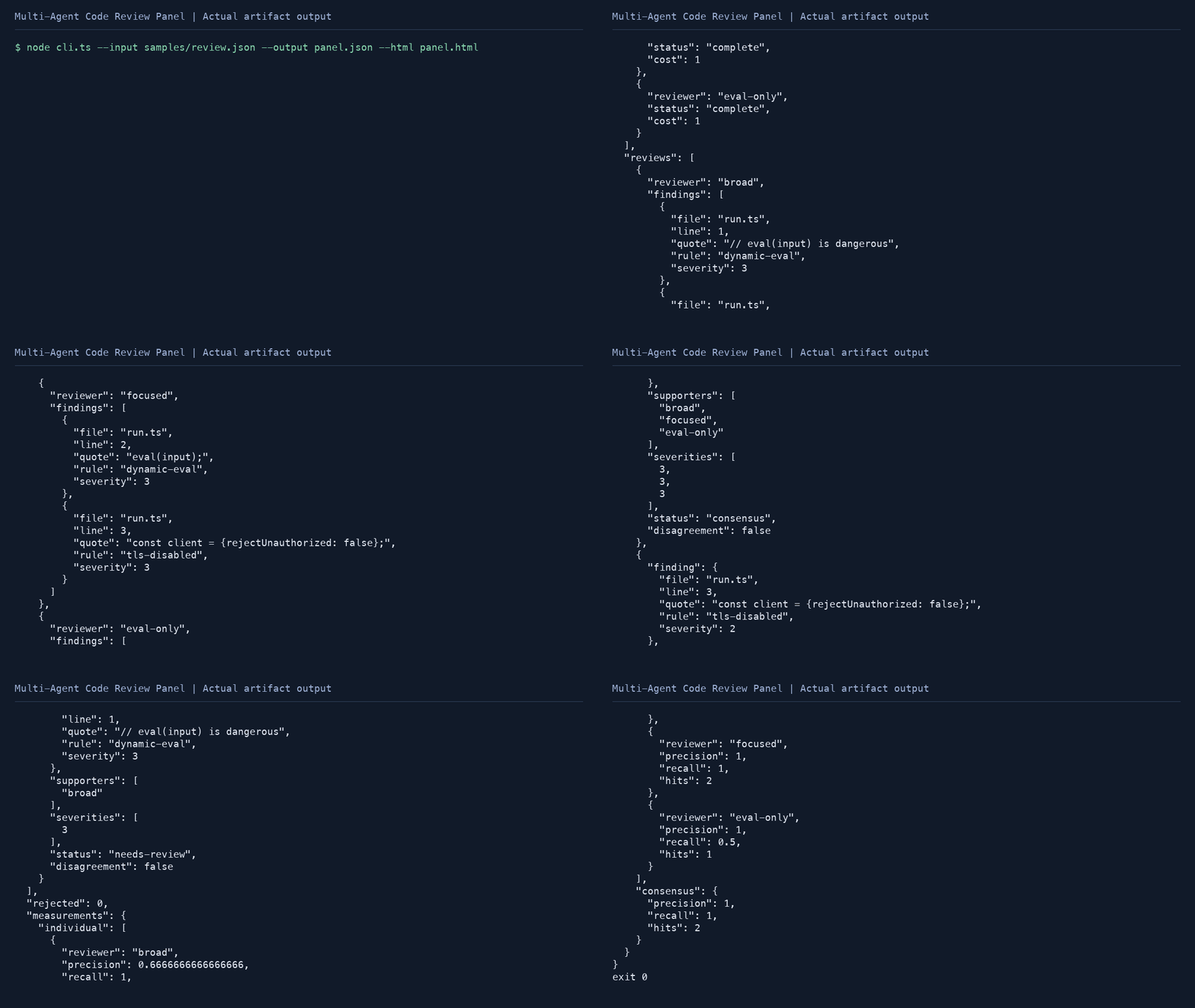
node cli.ts --input samples/review.json --output panel.json --html panel.html
The driver and offline samples are provided scaffolding. Its imports resolve to your implementation. Public input types and function signatures live in the starter and API contract.
Inspect the reference separately
From the repository root:
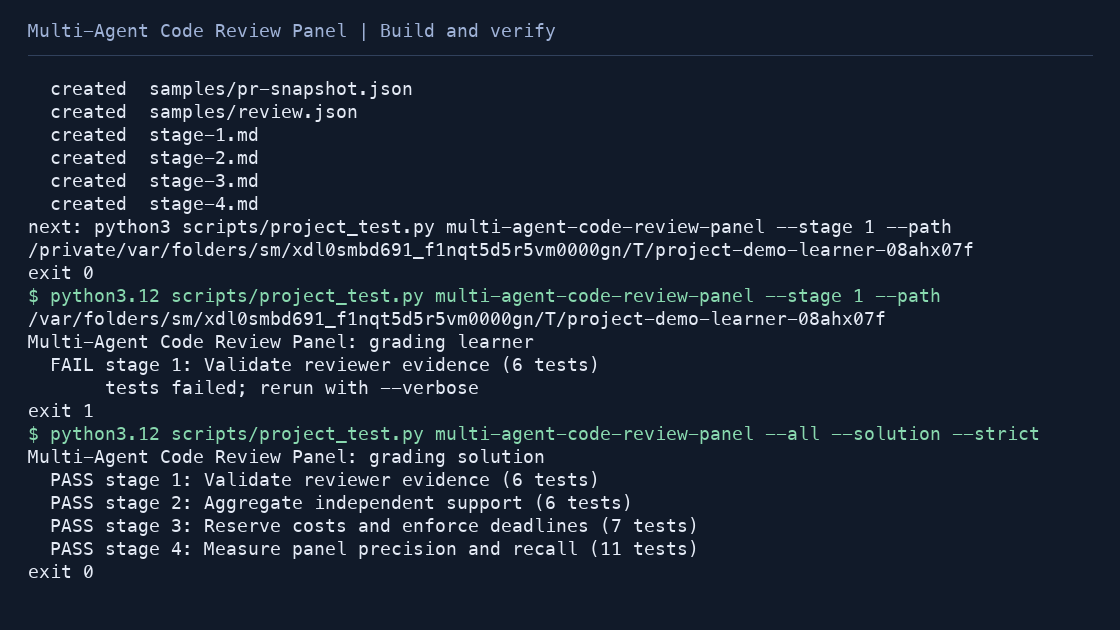
python3 scripts/project_test.py multi-agent-code-review-panel --all --solution --strict
cd projects/multi-agent-code-review-panel/solution
node cli.ts --input samples/review.json --output panel.json --html panel.html
Observe the change
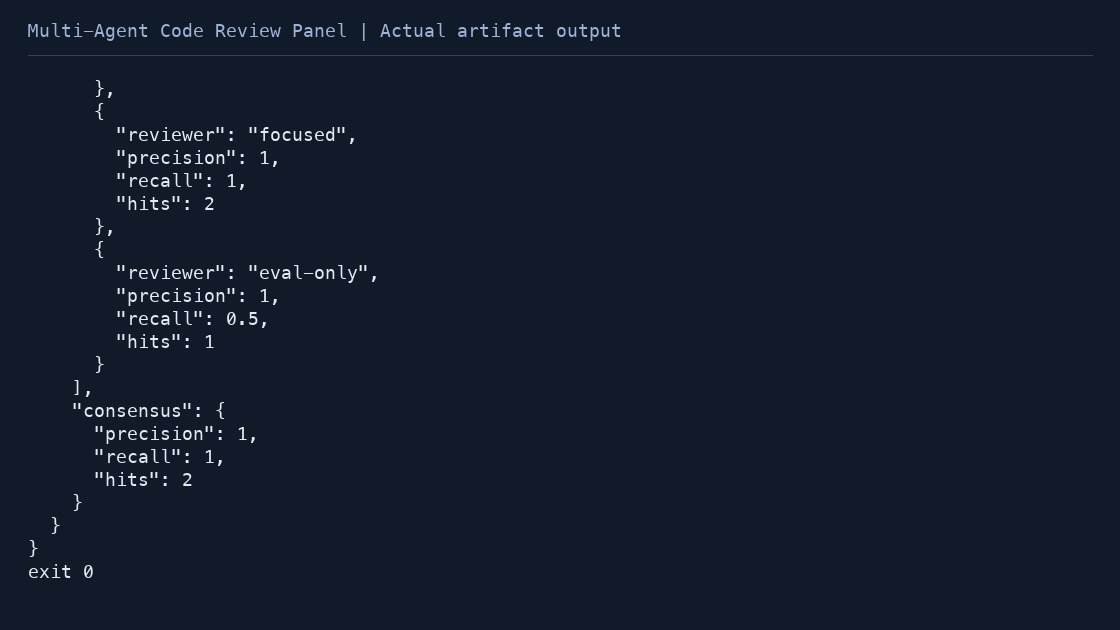
The broad reviewer flags a comment and two real candidates: precision 2/3. Quorum removes the lone comment false positive and reaches precision 1 while preserving the TLS severity disagreement. A budget of1 produces no consensus.
Edit a copy of the sample and rerun the command. Keep the input beside the output so someone else can reproduce the result; the supplied samples are authored teaching data.
Integration and limits
Input files maps names to text or lines. Optional reviewers contain id,cost,findings recordings. Expected labels use {file,line,rule}; the report records the source fingerprint and per-reviewer versus consensus metrics.
Local reviewers are distinct static heuristics, not independent LLMs. Consensus measures support, not truth. External callbacks must honor AbortSignal; timeout cannot undo a remote side effect.
Stages
- Validate reviewer evidence
- Aggregate independent support
- Reserve costs and enforce deadlines
- Measure panel precision and recall
Primary references
AbortController in Node Node test runner
Reuse a PR review receipt
Run PR Review Reporter on an authored diff, then provide its schema_version1 output with --pr-report /path/review.json and a matching full source snapshot:
node cli.ts --input samples/pr-snapshot.json --pr-report /path/review.json --output composed-panel.jsonThe adapter converts high/medium/low severity to3/2/1, preserves file/line/rule identity and records pr_diff_sha256. Imported findings still pass the panel's source quote gate. This proves artifact compatibility; it does not turn correlated lexical detectors into independent judgments.