Help SDK authors choose retry behavior when many clients fail together. Replay concurrent clients against a deterministic service model, compare bounded backoff and jitter with a shared retry budget, then run the same policy against a local HTTP fixture. Export amplification and recovery timelines with a reusable client policy.
Standard libraries only. Four stages, approximately eight hours. Go, TypeScript implementations are exercised by the grader.
Build it
- Model concurrent failures with a deterministic clock
- Compare bounded backoff and jitter
- Enforce shared retry budgets and server delays
- Replay against a local HTTP service
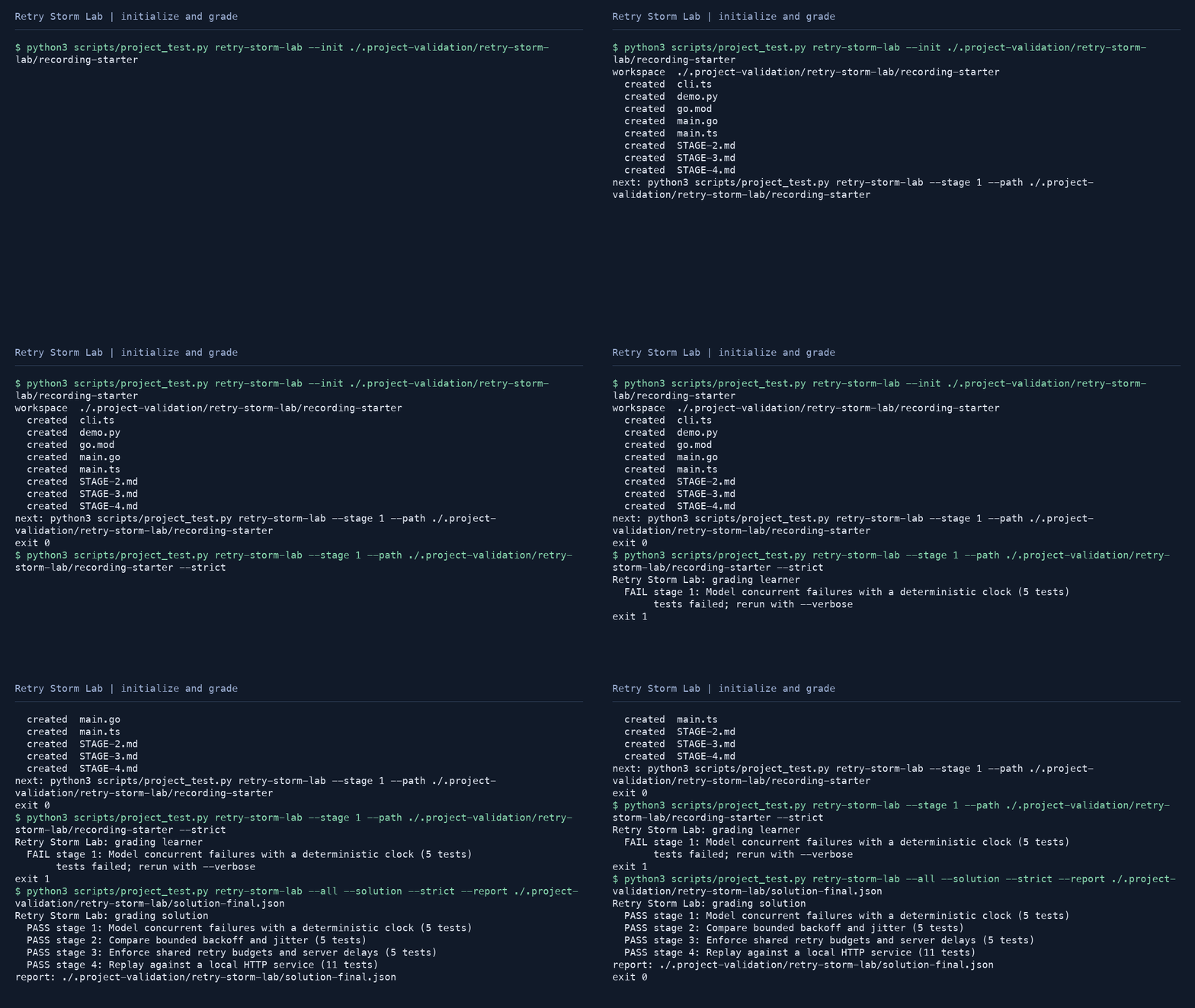
python3 scripts/project_test.py retry-storm-lab --init /tmp/retry-storm-lab-work
python3 scripts/project_test.py retry-storm-lab --stage 1 --path /tmp/retry-storm-lab-work --strict
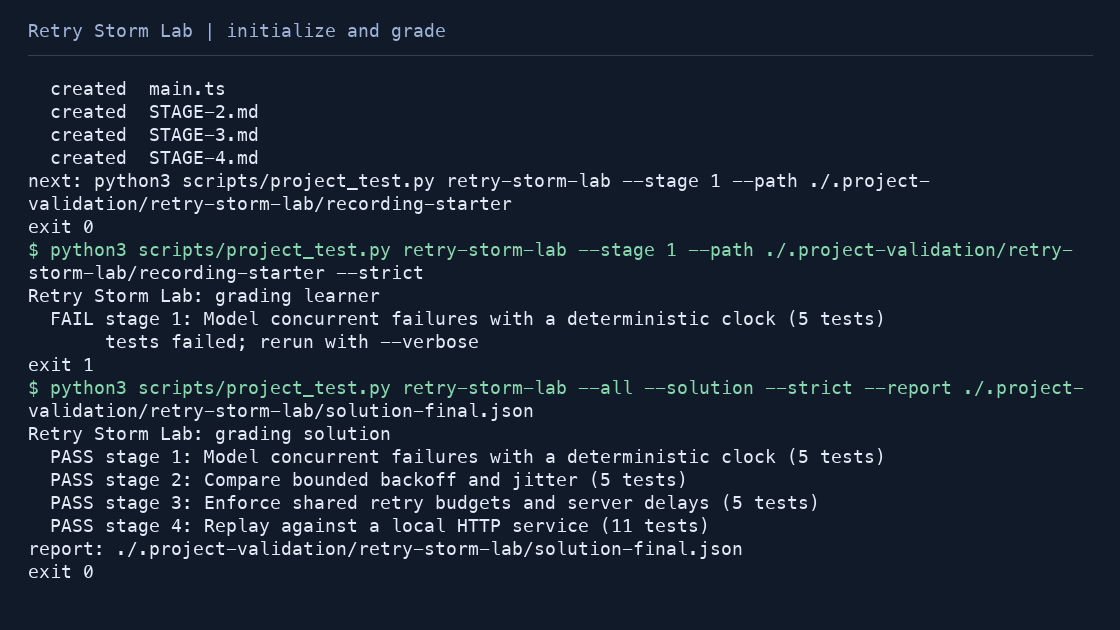
python3 scripts/project_test.py retry-storm-lab --all --solution --strict
The fresh starter fails until you implement it. Reference-solution runs never grant learner completion certificates.
Run controlled comparisons
cd projects/retry-storm-lab/solution
go run . --clients 20 --budget 60 --jitter=false --out /tmp/synchronized.json
go run . --clients 20 --budget 60 --jitter=true --seed 7 --out /tmp/jittered.json
go run . --clients 20 --budget 12 --seed 7 --out /tmp/retry.json
node --experimental-strip-types cli.ts /tmp/retry.json /tmp/amplification.json
go run . --local-http --clients 20 --budget 12 --out /tmp/retry-wire.json
node --experimental-strip-types cli.ts /tmp/retry-wire.json
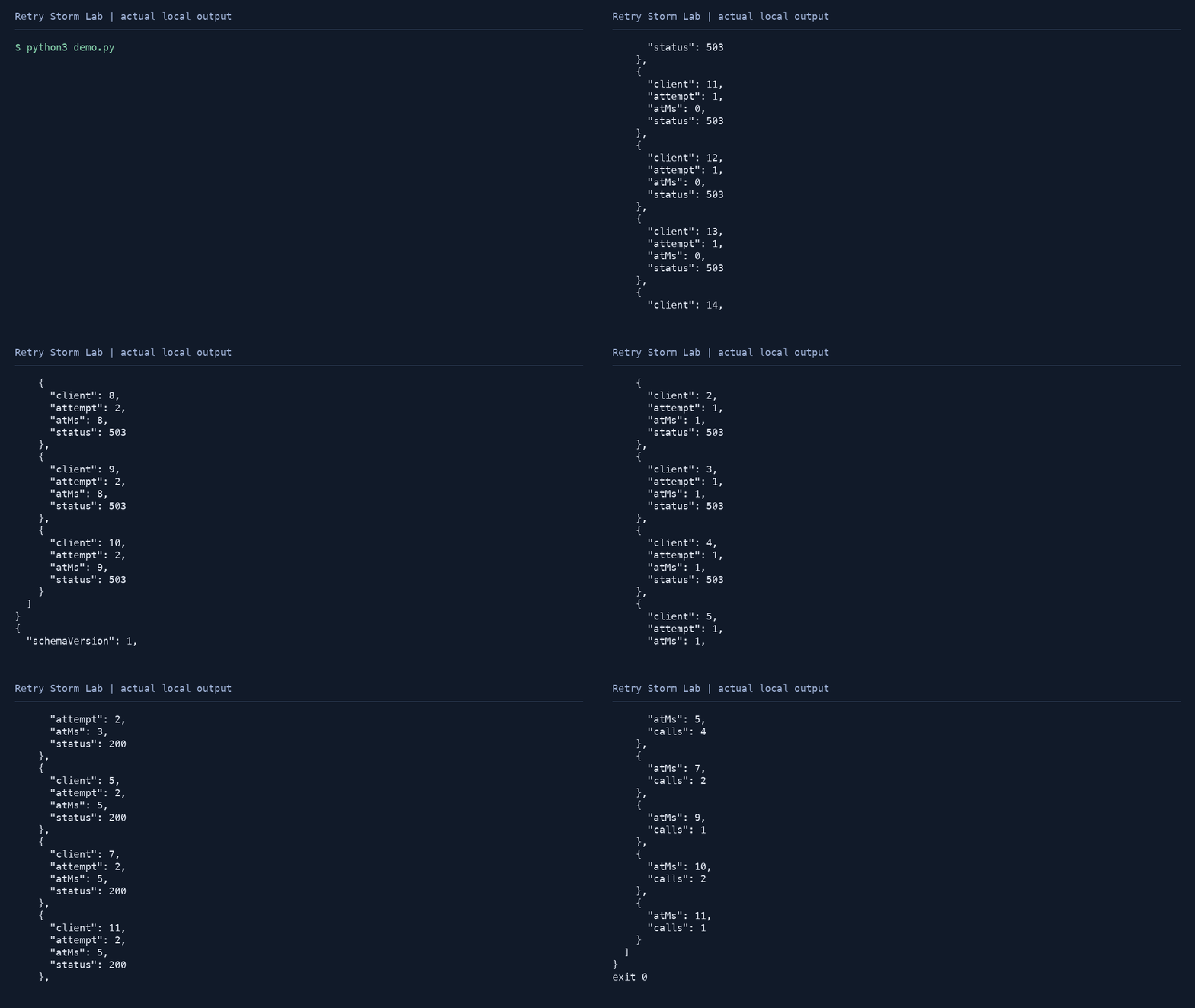
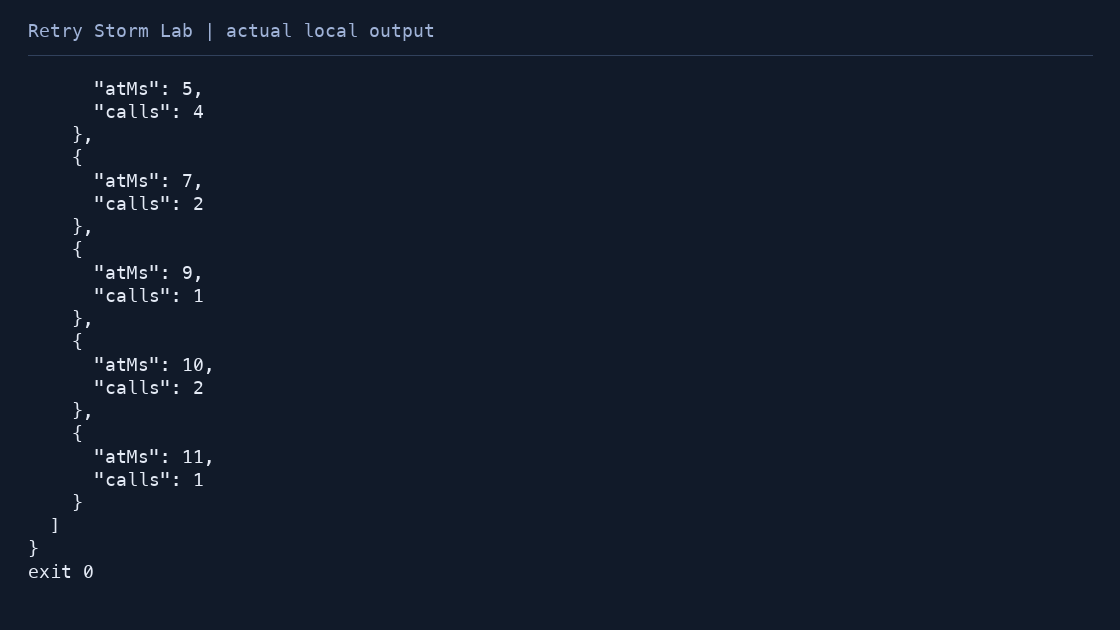
python3 demo.py
Use --base-ms, --max-ms and --attempts to set policy bounds. Simulation inputs --fail-until-ms and --capacity change the failure window and per-millisecond capacity. --jitter=false preserves synchronized exponential waits; --jitter=true applies seeded spreading.
The simulator is a discrete, exact-millisecond capacity model. The real loopback fixture returns one 503 per client and then 200; it does not model an external service's capacity. JSON mode distinguishes the two. TypeScript consumes the Go receipt, verifies all counters and exports an amplification timeline.
Reuse the Go Fetch client with your context, bounded http.Client and URL. It performs GET only, returns each observed attempt and does not retry transport errors or nonlisted statuses. Server Retry-After above the policy cap ends the request. Redirect behavior and connection limits belong to the supplied HTTP client. Cancellation limits waiting; it does not prove upstream work stopped. The default Local adapter sets a two-second per-client deadline.
The budget is in-process and shared by the fixture's clients. It never claims transactional rollback or coordination across processes. Live peaks align each client's elapsed clock, while simulation peaks share one exact clock. RFC 9110 specifies Retry-After.
Completion evidence
python3 scripts/project_test.py retry-storm-lab --all --path /tmp/retry-storm-lab-work --strict --report /tmp/retry-storm-lab-result.jsonLocal reports are unsigned, self-reported evidence. The editable figures calculate illustrative values; the CLI runs the actual implementation.