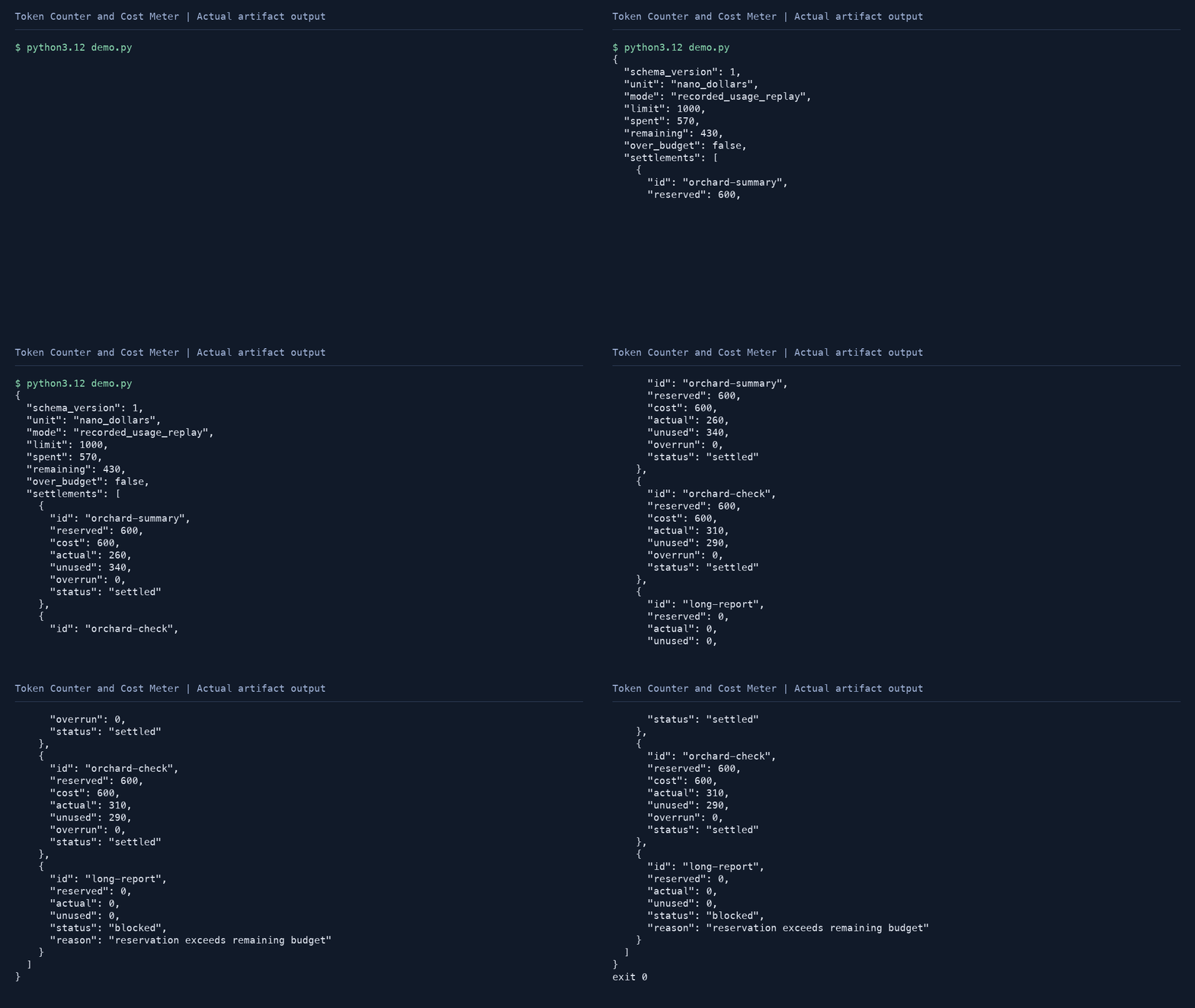
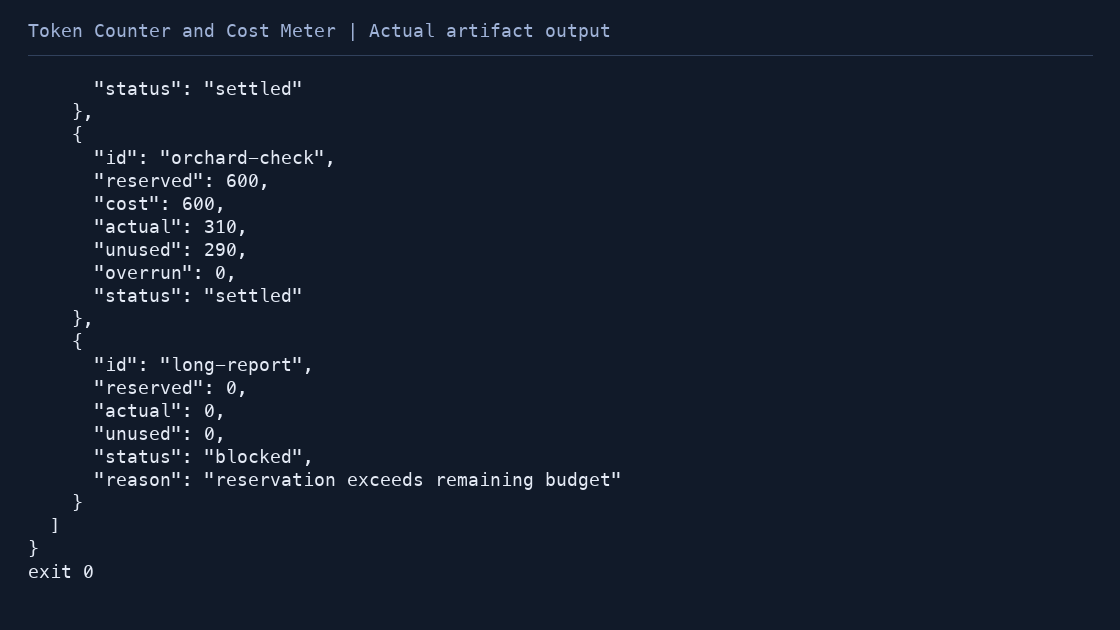
Usage reconciliation explaining why real billing differs from preflight estimates.
Start with a visible approximation. At four characters per token, 21 Unicode scalar values estimate six tokens. This is a baseline for preflight planning; actual provider counts can differ by language, punctuation and tokenizer.
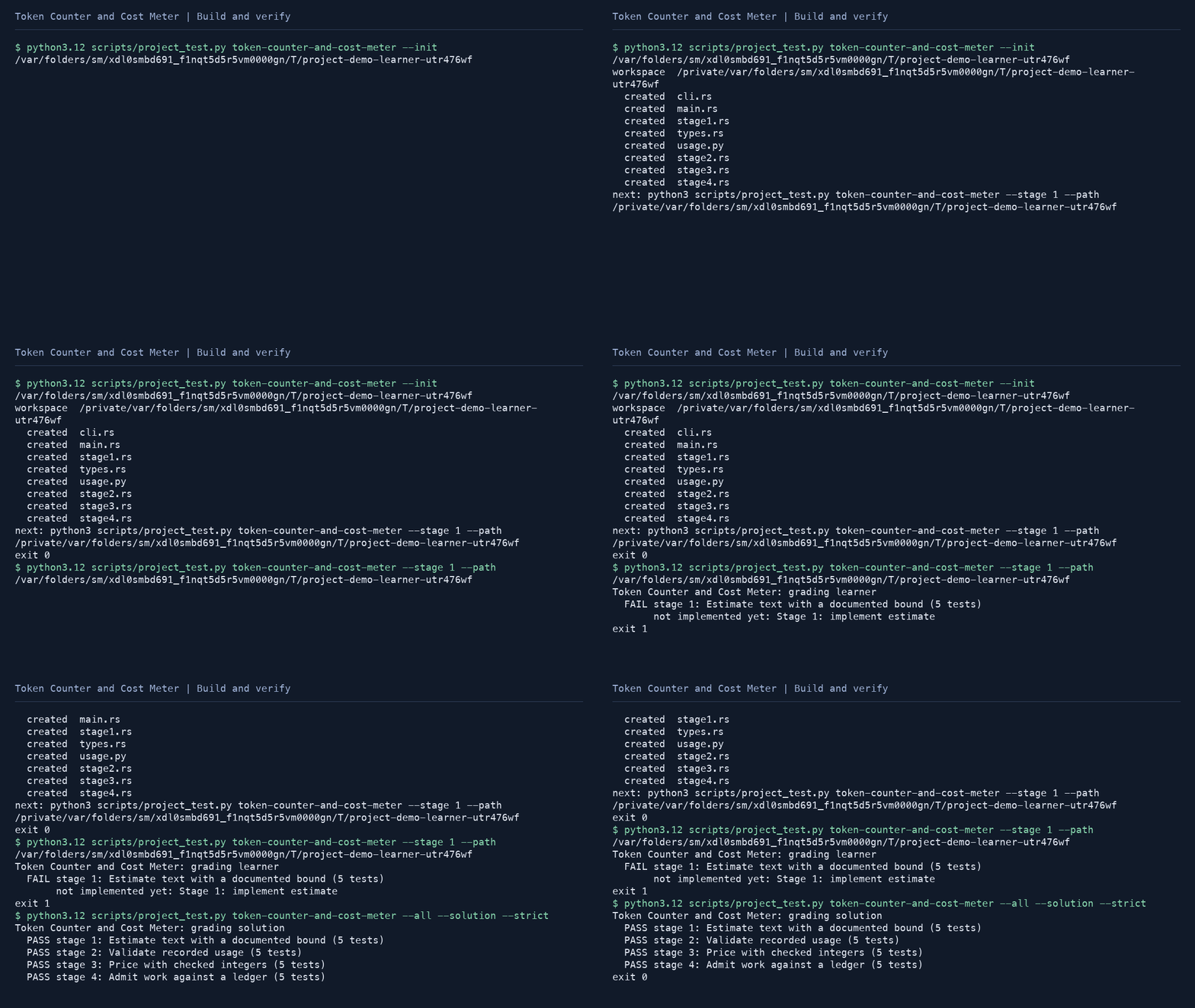
Start with a learner workspace
Tokenizers, Verification gates. Language foundation: Rust ownership and Result.
Install Rust (rustc) and Python 3.10+. The core uses the Rust standard library; Python adapters compile into private temporary directories.
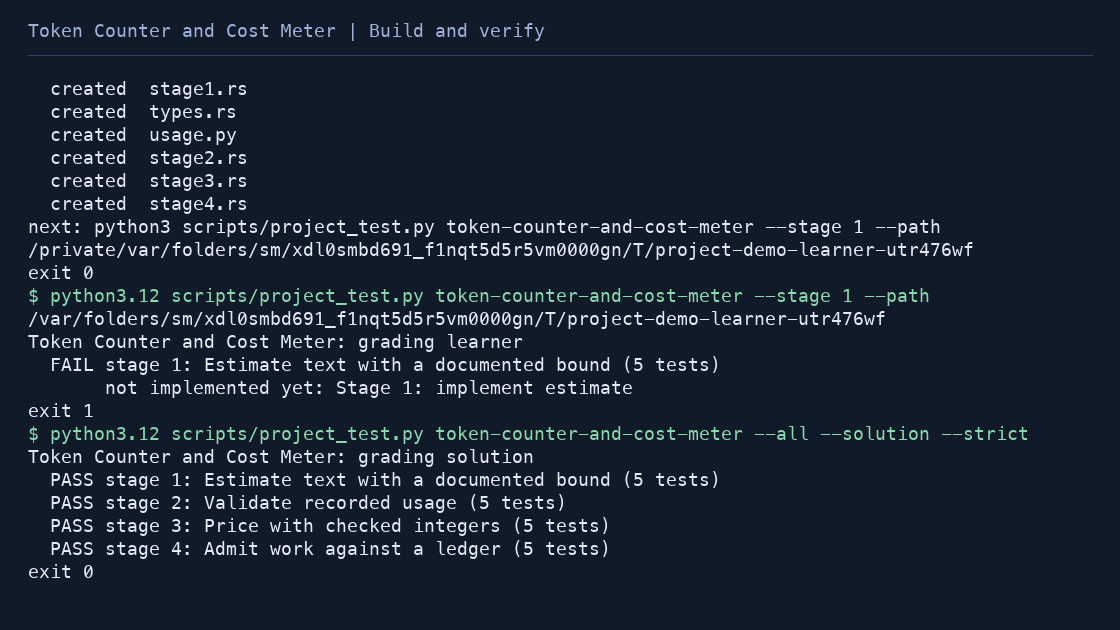
python3 scripts/project_test.py token-counter-and-cost-meter --init learning-artifacts/token-counter-and-cost-meter
python3 scripts/project_test.py token-counter-and-cost-meter --stage 1 --path learning-artifacts/token-counter-and-cost-meter
Build route
- Estimate text with a documented bound
- Validate recorded usage
- Price with checked integers
- Admit work against a ledger
Run with your own inputs
After completing the stages, these commands run your workspace code on the original Orchard examples. Replace the sample paths with your own files.
python3 learning-artifacts/token-counter-and-cost-meter/usage.py projects/token-counter-and-cost-meter/examples/usage.json --out usage-ledger.jsonTo inspect the complete reference first, replace learning-artifacts/token-counter-and-cost-meter with projects/token-counter-and-cost-meter/solution in the same command. JSON results use schema_version: 1; paths and argument examples are explicit so another tool can consume them.
Integration boundary
Rates are explicit fixture inputs in integer nano-dollars per token, not current provider prices. usage.py normalizes recorded usage JSON and delegates checked arithmetic to Rust. Its ledger is a sequential replay saved with --out; it is not a live billing service or concurrent reservation store.
python3 scripts/project_test.py token-counter-and-cost-meter --all --solution --strict
python3 scripts/project_test.py token-counter-and-cost-meter --all --path learning-artifacts/token-counter-and-cost-meter --strict
The first command checks the reference. The second checks your implementation. The published examples and tests are regression evidence, not a production certification or an unseen benchmark.